
Physical-world problem solving strengthens human creative intelligence.
Strengthening creativity in kids and teens through hands-on programs in fashion design, toy design and architecture in Bay Area, CA.
We are living in a moment of extraordinary technological progress. Digital tools have increased our productivity many folds, AI tools are faster, smarter, and more capable every month. It begs us to ask the question: Does the art and practice of making with physical materials matter? The response is a resounding YES! This work feels more important than ever—grounded in a simple truth: our home is still the physical world—one shaped by physics, limits, friction, gravity, and time.
And that matters, especially for young people.
When a child designs something on a screen, they can generate endless variations in seconds. But when they build something with their hands, reality shows up. A seam pulls. A joint won’t hold. A wheel wobbles. Cardboard bends. The material pushes back. And that pushback is not a problem—it’s the point.
Because physical making trains the mind in a way digital output can’t fully replicate.
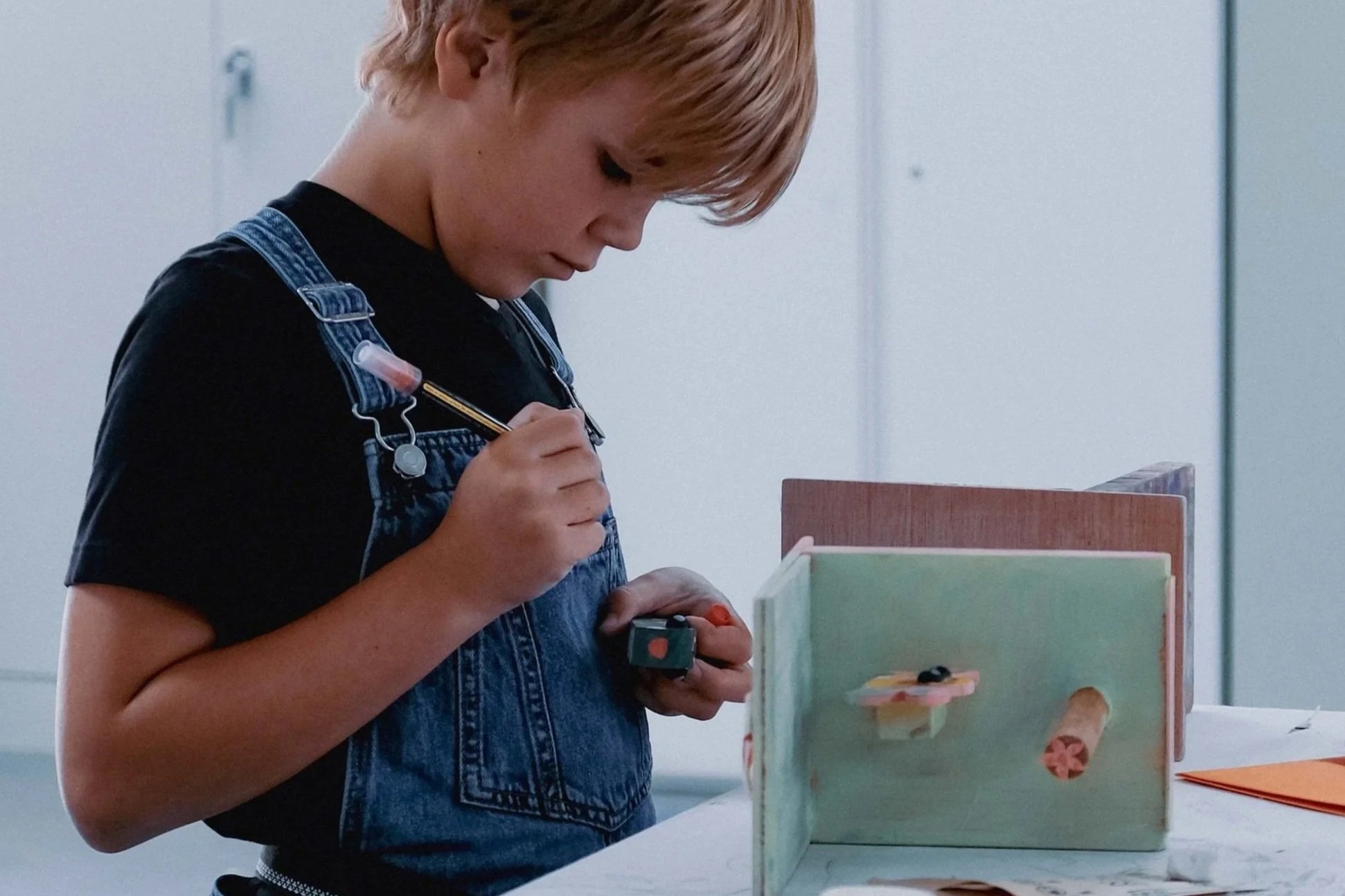
A young student completely present and in moment in the product design program at DesignX summer camp
In a hands-on design studio, students learn focus. They have to stay with a task long enough to understand it. They learn patience because real work takes real time. They learn perseverance because the first attempt is rarely the final one. And they learn presence—something increasingly rare—because the body is involved. You can’t “half-show-up” when you’re cutting, pinning, shaping, measuring, and assembling. The work asks for attention.
Physical making matters because the human experience is fundamentally physical. When kids work with real materials, constraints, and challenges, they build human capacity—not just creative output. Imagination doesn’t only live in the head; it lives in the body—through touch, movement, rhythm, and sensory feedback. When kids make something real, their ideas become concrete. They can feel the weight of a prototype. See proportion in three dimensions. Understand structure by testing it. Learn cause and effect by adjusting, refining, and trying again.
Physical constraints are powerful teachers. A limited set of materials or fabrics forces resourcefulness. A time window teaches prioritization. A tool teaches care. And a finished object—something a student can hold in their hands—creates a unique kind of confidence: I made this. I worked through the hard parts. I completed it.
That confidence carries far beyond the studio.
DesignX summer programs are built around this philosophy. Students learn through real design practice—working with materials, testing ideas, collaborating with peers, and completing meaningful projects. It’s joyful, yes. But it’s also formative: it strengthens attention, builds resilience, and grounds creativity in the real world.
To learn more about the various design programs offered by DesignX visit DesignX Studios. To register for DesignX summer programs visit summer programs 2026.