
Creativity in the Age of AI
Why the future will continue to require human making, judgment, and imagination.
As technologies that expand creativity continue to advance rapidly, it is becoming increasingly important to ask a fundamental question about what kind of progress we want to be making. At DesignX, we believe creativity is a form of human intelligence—one that develops through direct engagement with the physical world. In a moment when humans and machines create side by side, the essential question for learning, and therefore education, is not what technology can generate, but what kinds of thinking, feeling, and understanding are cultivated along the way.
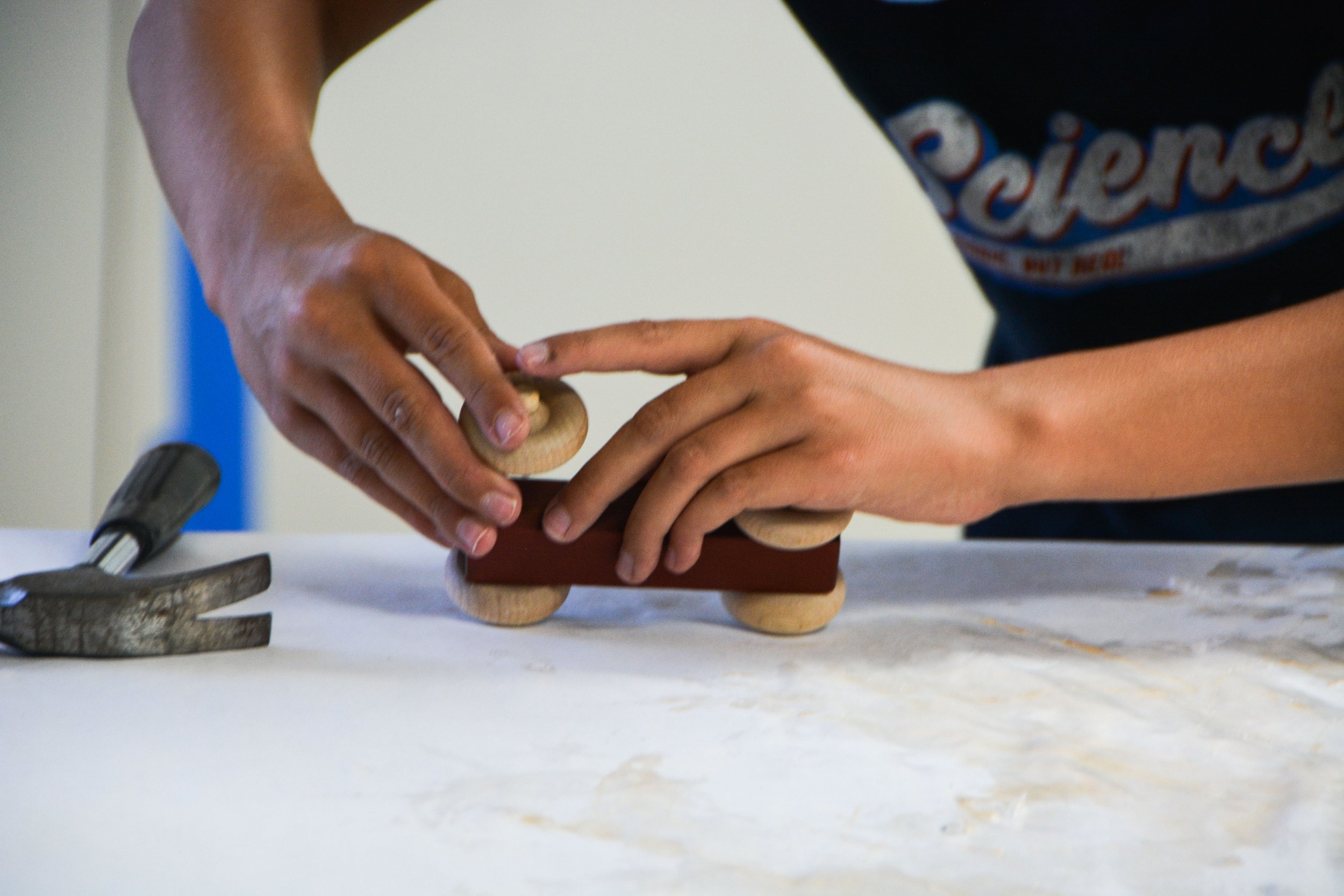
Student adjusting a wheel in Wood Toy Design Program at DesignX
AI is rewriting the entire creative landscape. With a few words of instruction, a system can now paint, compose, illustrate, or design at a level that once took years of human practice. It feels like magic — a spark of limitless possibility that collapses the distance between idea and outcome. It is exciting.
Technology can expand creative thinking, inspire new directions, and make design more accessible than ever. In this rapidly shifting environment, we at DesignX, are called to ask a deeper question: What happens to the human mind when the process of creating becomes frictionless?
When a machine can generate infinite variations in seconds, the role of the human shifts — from maker to editor, from doer to director. We become curators of outcomes rather than participants in the journey. That’s still creative work, but it lives at a different altitude. It’s faster, lighter, more conceptual — and sometimes, less felt.
In that shift, something essential risks being lost: the embodied intelligence that grows when we slowdown and embrace the friction.
In our studios, when students cut, sew, build, or draw, they’re not just executing an idea — they’re learning through resistance, through material feedback. They feel texture, balance, and proportion. They develop intuition — that deep, wordless understanding of why something works. When AI skips that process for us, the result can be impressive, but the learning may be shallow.
The drive toward frictionless creation mirrors a broader truth about our times. For more than a decade, technology has promised to make everything faster, simpler, and more efficient — from how we shop to how we communicate. But as efficiency has increased, depth has often diminished, sadly. Attention has fragmented. The spaces for reflection, connection, and craftsmanship have quietly eroded.
Creativity in the physical world restores those spaces. Paint dries. Seams tear. Ideas fail. And in those pauses and problems, young designers learn resilience, adaptability, and reflection — qualities that speed and automation can quietly erase.
AI does not destroy human creativity; it changes its texture. AI creativity is expansive, fast, and iterative. Human creativity is embodied, interpretive, and relational. One scales possibility; the other anchors meaning. Together, they can be powerful — if we hold close the one we can’t afford to lose.
by Durga Kalavagunta
Founder of DesignX — a creative education studio that nurtures playful curiosity into lasting creativity.